Part Appendix · Practical Tools
Appendix IInstitutional Adoption Examples
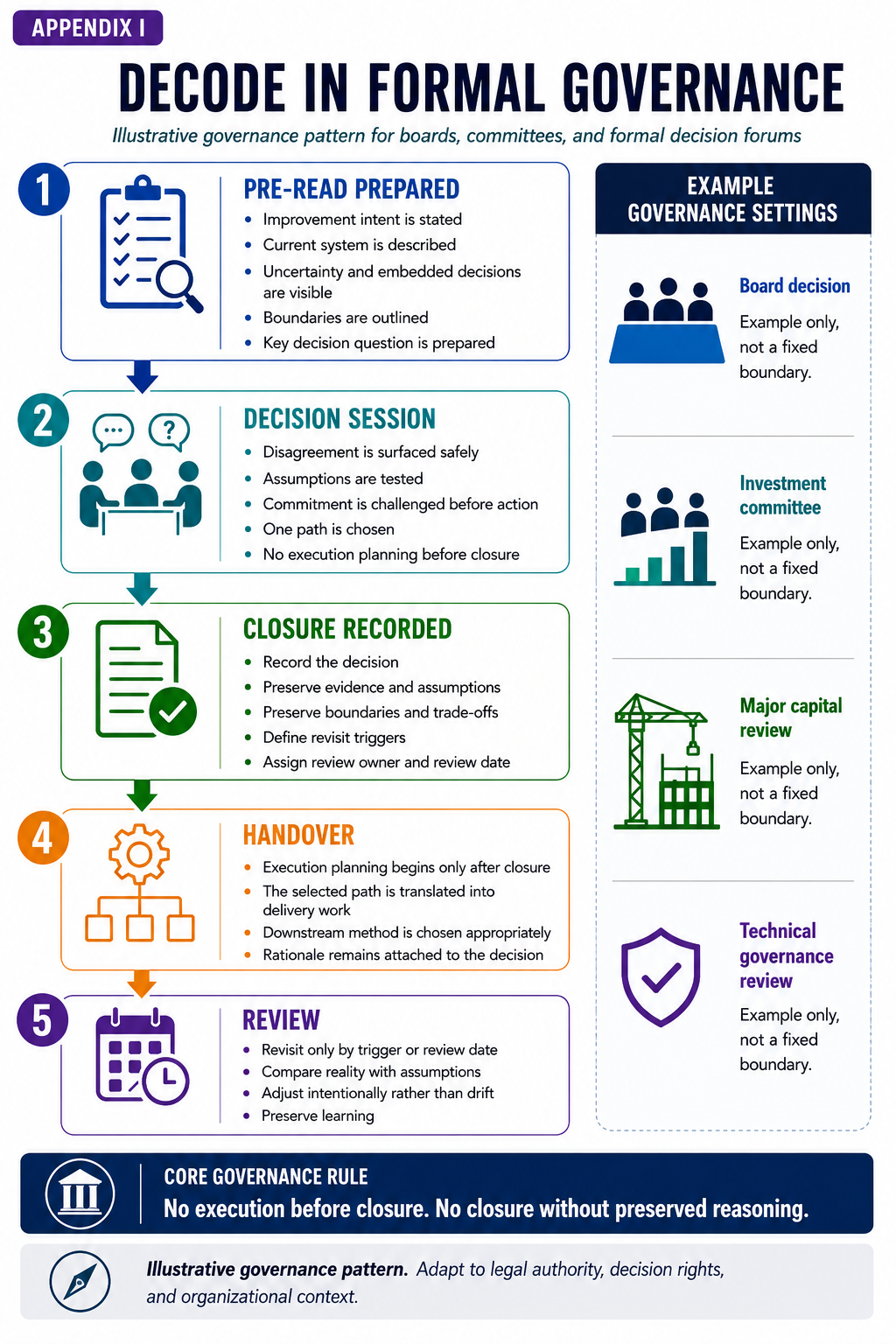
This appendix contains examples of how DECODE logic may appear in formal governance contexts such as boards and investment committees. These examples are illustrative. They are not required to apply DECODE and should be adapted to organizational context and legal requirements.
The canonical DECODE outcomes remain Improve, Redesign, and Preserve. The governance language used in the examples below is context-specific and does not create additional DECODE outcomes.
Board Pre-Read / Decision Under Uncertainty#
Purpose of This Discussion#
This item concerns a potential commitment with material impact on the organization’s structure, resources, or future options. The decision under consideration may affect capital allocation, strategic direction, operating model, governance, or long-term risk exposure. Once made, reversal may be difficult, costly, or reputationally sensitive. The purpose of this discussion is to determine whether commitment is justified at this stage, and if so, to what extent. This discussion is not an execution review.
Why This Matters Now#
The organization is considering change because a meaningful opportunity, risk, or capability gap has been identified. The question before the Board is not whether action is possible, but whether action is warranted given current understanding, uncertainty, and constraints. In situations of uncertainty, premature commitment is a common source of long-term cost, rework, and strategic drift.
Current Situation Overview#
The situation involves a system with multiple interacting elements, including internal capabilities, external conditions, historical decisions, and existing commitments. Understanding is partial. Some facts are known. Other aspects remain uncertain or contested. Multiple interpretations may reasonably exist at this stage. This discussion is intended to surface that uncertainty rather than suppress it.
Key Considerations for the Board#
The following questions frame the decision:
- Why is change being considered, and what value or risk is at stake
- What is known about the current system as it exists today
- Which past decisions or constraints shape the current situation
- Where are the boundaries beyond which change becomes unsafe or impractical
- What level of commitment is being proposed, if any
- Under what conditions would this decision need to be revisited These questions may not all be fully resolved. The Board’s role is to judge whether understanding is sufficient to justify commitment.
Decision Options#
The Board is asked to consider one of the following outcomes:
- Approve commitment to proceed
- Direct material redesign or reframing before commitment
- Decide not to proceed at this time Deferral without explicit direction is not considered a decision outcome.
Closure and Learning#
If a decision is made, the reasoning supporting it will be explicitly recorded, including key assumptions, accepted trade-offs, and conditions that would trigger reconsideration. This is intended to preserve clarity over time and support learning, not to predict outcomes.
What Is Out of Scope#
Detailed execution planning, implementation sequencing, or performance management is not in scope for this discussion and will follow only if commitment is approved.
Board Expectation#
The Board is asked to engage with the decision logic, not to validate predetermined outcomes. Disagreement and questioning are expected and appropriate at this stage.
Investment Committee Policy#
Decision Discipline for High-Impact Transactions#
Purpose#
The purpose of this policy is to ensure that high-impact investment and transaction decisions are made with explicit, defensible reasoning before commitment occurs. The organization recognizes that execution excellence does not compensate for weak or premature commitment. This policy establishes when structured decision discipline is required and when it is intentionally not applied.
Scope of Application#
Structured decision discipline using the DECODE logic is required for transactions where:
- Uncertainty is material
- The cost of reversal is high
- Commitment alters capital structure, control, governance, or strategic direction This includes, but is not limited to:
- Platform acquisitions
- Control transactions
- Material minority investments with governance rights
- Joint ventures or partnerships that create operational dependency
- Capital investments that materially alter asset structure or capability Transaction size alone does not determine applicability. Structural impact does.
Transactions Excluded From DECODE#
DECODE shall not be applied to transactions where decision discipline would add friction without improving decision quality. Explicit exclusions include: Reversible Options Transactions that can be exited with minimal financial, reputational, or strategic cost, including:
- Non-binding option agreements
- Explicit learning investments with clean exit clauses Mandated Transactions Transactions where the decision is not genuinely open, including:
- Regulatory or court-mandated actions
- Transactions required by parent or controlling authority Formulaic Add-On Transactions High-volume acquisitions executed under an established and intentionally standardized playbook, where:
- Strategic intent is predefined
- Integration approach is fixed
- Primary risk lies in execution, not decision framing Emergency Transactions Actions required to preserve solvency, licensing, or immediate operational continuity, where delay materially increases existential risk. In such cases, abbreviated decision framing may be applied at the discretion of the Chair. Symbolic or Signaling Investments Transactions undertaken primarily for market presence, signaling, or optionality, without intent to materially alter the operating system. Post-Commitment Review DECODE shall not be used to justify or document decisions that have already been made implicitly or explicitly.
Required Decision Discipline#
When applicable, the following questions must be resolved explicitly before commitment:
1. Why is this transaction worth considering now? 2. What system is being entered or altered as it exists today? 3. Which past decisions and constraints shape this system? 4. What boundaries cannot be crossed safely or responsibly? 5. What is the explicit commitment being made? 6. Under what conditions would this decision be revisited? These questions may be addressed in written or verbal form, but the logic must be clear and reviewable.
Decision Outcomes#
The Investment Committee recognizes only three valid decision outcomes:
- Proceed
- Redesign the opportunity materially
- Do not proceed Conditional enthusiasm, further exploration without decision, or implicit momentum do not constitute valid outcomes.
Closure and Record#
All decisions subject to this policy must include explicit closure. Closure includes:
- The decision taken
- The evidence and primary reasoning supporting it
- Key assumptions
- The boundaries and scope of the decision
- Accepted trade-offs
- Defined revisit conditions
- A review date or review condition Closure exists to preserve reasoning, not to predict outcomes.
Authority and Enforcement#
The Chair of the Investment Committee is responsible for enforcing this policy. The Chair may:
- Pause deliberations when understanding is insufficient
- Redirect discussion away from execution or valuation prematurely
- Defer decisions that cannot be stated clearly Failure to apply this policy does not invalidate a decision, but repeated deviation shall be reviewed as a governance issue.
Review and Maturity#
This policy is intended to support decision quality, not procedural compliance. As decision discipline matures, the visible use of structured formats may decrease. The underlying logic and expectations remain. Selective application of this policy is a sign of maturity, not an exception.
Board Meeting Closing Page#
Decision Record#
Decision Context#
This decision concerns a commitment with material impact on the organization’s structure, resources, or future options. The Board has considered the decision under conditions of uncertainty and recognizes that the quality of reasoning at the time of commitment is as important as outcomes that follow.
Decision Taken#
The Board has decided to: ☐ Proceed with commitment ☐ Proceed subject to material redesign or reframing ☐ Not proceed at this time Decision summary One or two sentences stating what is being committed to or explicitly not committed to.
Evidence and Reasoning at the Time of Decision#
The Board’s decision is based on the following considerations:
- The primary value, opportunity, or risk driving the decision
- The current understanding of the situation or system involved
- Key constraints or boundaries influencing the decision
- The balance of trade-offs accepted at this stage This reasoning reflects conditions and information available at the time of the decision.
Key Assumptions#
The Board acknowledges that the decision rests on the following assumptions:
- Assumption 1
- Assumption 2
- Assumption 3 These assumptions may be revisited if conditions change.
Decision Boundaries and Scope#
The Board acknowledges that this decision applies within the following boundaries and scope:
- Boundary or scope condition 1
- Boundary or scope condition 2
- Boundary or scope condition 3
Trade-Offs Accepted#
In making this decision, the Board has explicitly accepted the following trade-offs:
- Trade-off 1
- Trade-off 2 These trade-offs were considered reasonable given the intent and context of the decision.
Revisit Conditions#
The Board directs that this decision be revisited if any of the following conditions occur:
- Trigger 1
- Trigger 2
- Trigger 3 Absent these conditions, the decision stands.
Review Date or Review Condition#
This decision will be formally reviewed: A scheduled review does not reopen the decision automatically. Reconsideration occurs only if the review identifies a material change in the reasoning, assumptions, boundaries, or revisit conditions.
What Is Not Included#
This decision does not include:
- Execution plans or implementation detail
- Performance targets or milestones
- Resource allocation specifics beyond the commitment itself These matters will be addressed separately following this decision.
Closure Statement#
With this record, the Board considers the decision closed. Subsequent actions are expected to align with the commitment and reasoning documented above. Any material deviation shall be treated as a new decision requiring explicit consideration.