Part III · The DECODE Logic / The Core
11Outline Change Boundaries
O Outline Change Boundaries#
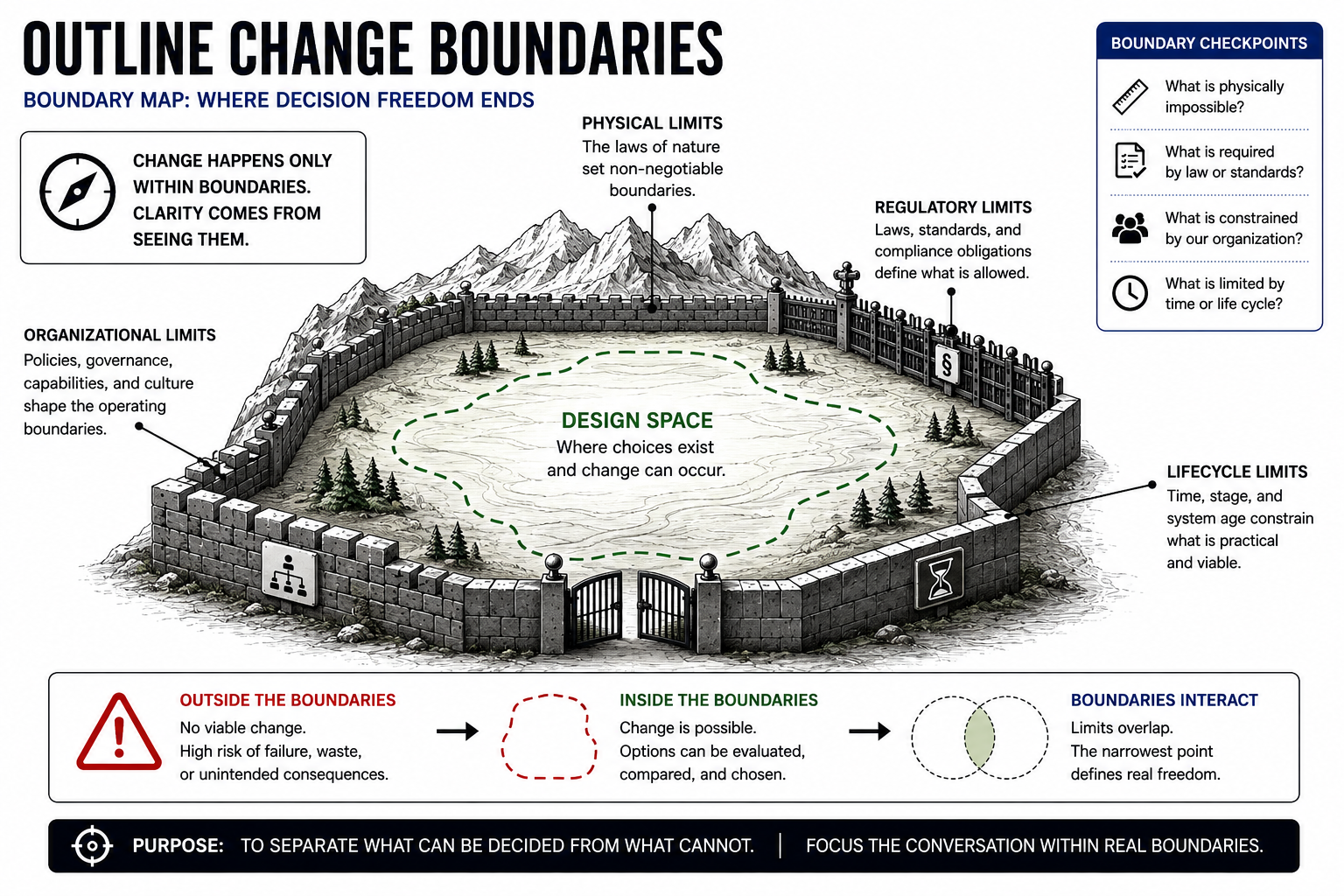
Every decision becomes dangerous the moment its boundaries are discovered too late. Once embedded decisions have been clarified, the next question is not what could be changed, but what must not be crossed. This step exists to make limits explicit before options are evaluated. Without clear boundaries, teams explore ideas that feel promising but cannot be realized safely, legally, or responsibly. By the time those limits surface, commitment has often already occurred. Outlining boundaries early protects decision quality by constraining imagination to what is actually possible.
Where Change Becomes Unsafe#
Not all change is equal. Some changes introduce risk that is acceptable and reversible. Others create exposure that is unsafe, irreversible, or disproportionate to the intended benefit. These thresholds are rarely visible at the outset unless they are named deliberately. Unsafe change may involve safety, compliance, reliability, brand, or long-term viability. It may also involve human factors such as workload, skill erosion, or loss of critical knowledge. DECODE does not attempt to calculate risk precisely at this stage. It identifies where exploration must stop. Knowing where change becomes unsafe prevents enthusiasm from overriding judgment.
Boundaries Versus Assumptions#
Boundaries are often confused with assumptions. A boundary is a limit that cannot be crossed without violating reality. It may be physical, regulatory, contractual, or organizational. Crossing it would require redefining the system itself. An assumption is a belief about how the system works or what is possible. Assumptions may be true or false. They should be tested later. Confusing the two is costly. When assumptions are treated as boundaries, options are prematurely eliminated. When boundaries are treated as assumptions, teams explore paths that will eventually fail. This step exists to separate the two.
Hard and Soft Boundaries#
Not all boundaries are equal. Some are non -negotiable. Others reflect current capability rather than absolute constraint. Hard boundaries are limits that cannot be crossed without violating physical laws, regulatory requirements, or fundamental safety conditions. Treating them as negotiable creates unacceptable risk. Soft boundaries are limits that exist because of current skills, resources, structures, or investment choices. They can be changed, but not without cost or consequence. Confusing these two leads to poor decisions. Treating soft boundaries as hard prevents improvement. Treating hard boundaries as soft invites failure. Outlining boundaries makes this distinction explicit before options are evaluated.

The Cost of Discovering Boundaries Too Late#
Boundaries discovered late are rarely treated as signals. They are treated as obstacles. When options have already been favored, teams respond to newly discovered limits by working around them rather than reconsidering the decision itself. Complexity increases. Risk is accepted quietly. Early boundary clarity eliminates unsafe options before they become politically or emotionally costly. Killing a bad idea early feels unproductive. Carrying it forward is far more expensive.
Why Boundaries Kill Bad Ideas Early#
Clear boundaries eliminate options. This is not a flaw. It is a feature. By killing bad ideas early, boundaries prevent wasted effort, false hope, and expensive reversals. They focus exploration on options that have a chance of surviving contact with reality. Without boundaries, teams often fall in love with ideas that cannot be implemented. By the time constraints are acknowledged, political and emotional investment make it difficult to let go. Boundaries protect teams from their own optimism.
How This Step Shapes Decisions#
When boundaries are explicit, decision discussions change. Options are evaluated against limits rather than aspirations. Trade-offs become visible. Unrealistic paths disappear without debate. Most importantly, commitment becomes grounded. DECODE does not use boundaries to block change. It uses them to ensure that change is survivable.
Key Takeaway#
Boundaries define where decision freedom ends. By outlining physical, regulatory, and organizational limits early, DECODE prevents unsafe exploration and late-stage surprises. Before a decision can be made responsibly, the space in which that decision can exist must be clearly defined. Only then can options be evaluated honestly. The next chapter moves from boundaries to choice. With intent, understanding, and limits in place, a decision path can finally be selected.