Part IV · Using DECODE in Real Life
16Small Decisions, Big Damage
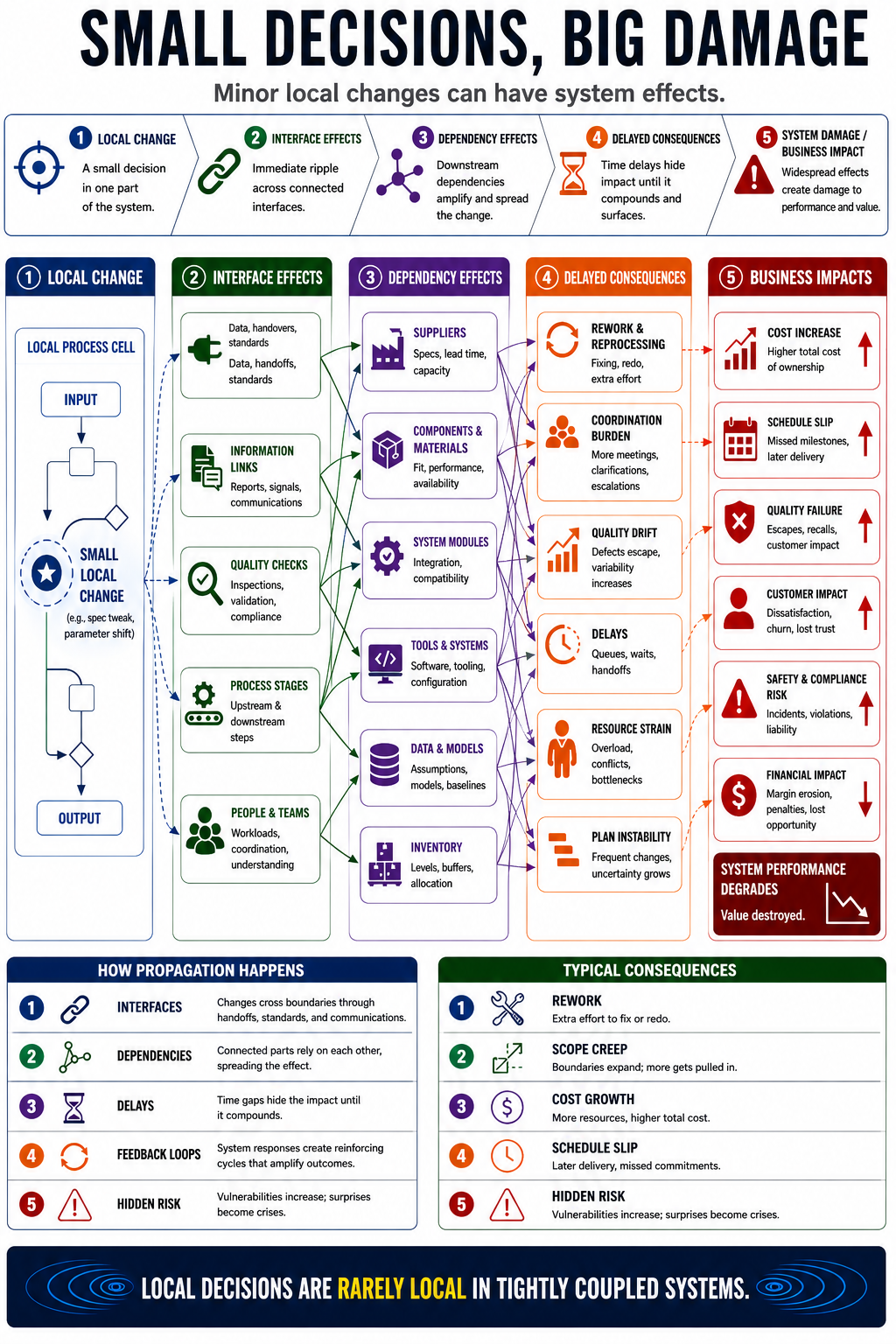
Most long-term damage begins with decisions that felt too small to question. Small decisions rarely feel dangerous. They appear local, inexpensive, and easy to reverse. They are often made quickly and informally. Precisely because of this, they accumulate unnoticed. The damage caused by small decisions is not proportional to their size. It comes from repetition, interaction, and normalization. What begins as an exception becomes a pattern. What begins as a workaround becomes a dependency. Large failures are easy to see. They attract attention, postmortems, and corrective action. Small decisions rarely do. They slip through because they appear local, harmless, or reversible. DECODE matters at small scale not because every small decision requires formal discipline, but because some local changes quietly reshape systems. This is also where decision discipline is most often abandoned and where its absence accumulates unnoticed.
Why Small Decisions Escape Scrutiny#
Small decisions are rarely framed as decisions at all. They are presented as adjustments, optimizations, or common-sense improvements. They do not trigger governance. They do not demand justification. They are often delegated and executed quickly. This informality feels efficient. It is also how organizations accumulate fragility without noticing. When small decisions are made without clarity of intent, system understanding, or boundaries, their effects compound. Over time, the system becomes harder to explain, harder to change, and harder to trust.
Material Changes#
Material changes are a common source of hidden risk. A substitution is made to reduce cost, improve availability, or align with a supplier. The change appears minor. Specifications remain within tolerance. Performance initially looks acceptable. What is often missed is how material properties interact with the rest of the system. Wear patterns change. Sensitivity increases. Failure modes shift. Interfaces that were stable become fragile. Because the change was small, its impact is often attributed elsewhere. The decision that introduced the risk fades from view. This is how technical debt begins.
Process Tweaks#
Process tweaks feel especially safe. Cycle time is reduced. A step is removed. Inspection is adjusted. A control is relaxed to improve flow. Each change appears rational in isolation. But processes are systems. Tweaks alter interfaces, feedback loops, and error propagation. What looks like efficiency at one point may increase variability or risk elsewhere. When intent is not explicit, teams optimize for local improvement without understanding global effect. Over time, the process becomes brittle and dependent on workarounds. The original decisions that shaped it are rarely revisited.
Harmless Optimizations#
Optimizations are often framed as harmless because they target efficiency rather than structure. Margins are tightened. Buffers are reduced. Tolerances are compressed. Flexibility is traded for speed. Each optimization may be justified individually. Together, they erode resilience. Because the decisions were small and incremental, no single one appears responsible. The damage emerges only when conditions change and the system can no longer absorb variation. At that point, recovery is expensive.
Typical Small Decisions With Outsized Impact#
Material substitutions made for short -term cost or availability reasons often change failure modes long after the decision is forgotten. Process tweaks introduced to relieve local pressure frequently create variability elsewhere that is harder to diagnose. Harmless optimizations aimed at efficiency can reduce resilience by removing slack that the system depended on implicitly. None of these decisions appear strategic at the moment they are made. Their impact becomes visible only after they interact with other changes over time.
Why DECODE Still Applies#
DECODE is not reserved for large initiatives. It applies whenever a decision changes the system in a way that is difficult to reverse. Scale is not measured by size, but by consequence. A small decision that alters material behavior, process stability, or interface robustness can have greater impact than a large project with clear boundaries. DECODE helps identify when a small decision is actually a structural one.
Cumulative Effect#
The danger of small decisions is not their individual impact. It is their accumulation. Each decision narrows options slightly. Each optimization reduces slack. Each tweak increases dependency. Over time, the system becomes tightly coupled and fragile. When failure eventually occurs, it appears sudden. In reality, it was constructed gradually. Decision discipline at small scale interrupts this pattern.
Key Takeaway#
Small decisions deserve discipline when their effects are structural or irreversible. Ignoring decision quality at small scale is how technical debt accumulates quietly. By the time the damage is visible, the decisions that caused it are forgotten. DECODE matters most where decisions feel too small to justify slowing down. The next chapter examines how DECODE interacts with existing methods and why it complements rather than replaces them.