Part III · The DECODE Logic / The Core
07The Six Letters
The Big Picture#
Understanding must come before commitment or the decision is already compromised. This chapter introduces the DECODE logic as a whole. The purpose here is not to explain how to perform each step. That work comes later. The purpose is to make the structure visible and to show why the order matters. DECODE is deliberately linear. It is not a cycle. Each step constrains the next. Skipping ahead weakens decision quality even when the final outcome appears reasonable. Understanding must be built before commitment occurs. Once commitment is made, learning changes its role. It no longer informs the decision. It justifies it. Seeing the full logic at once makes this separation explicit. This is the central principle behind DECODE. Everything in the method exists to protect this ordering. When understanding and commitment are allowed to blur together, decisions are made implicitly rather than deliberately. Momentum replaces judgment. Learning is used to justify action instead of shaping it. The six letters of DECODE are not steps for efficiency. They are safeguards against premature commitment.

Understanding Before Commitment#
Most organizations believe they decide first and execute later. In practice, commitment often occurs long before a formal decision is declared. Resources are allocated. Expectations are set. Teams are mobilized. By the time a decision is officially recorded, the organization is already committed. DECODE exists to interrupt this pattern. It forces understanding to be built explicitly before any commitment is allowed to occur. It creates a protected space where intent, system structure, boundaries, and assumptions can be examined without the pressure to act. This is not about slowing down. It is about preventing decisions from being made accidentally.
Why the Order Matters#
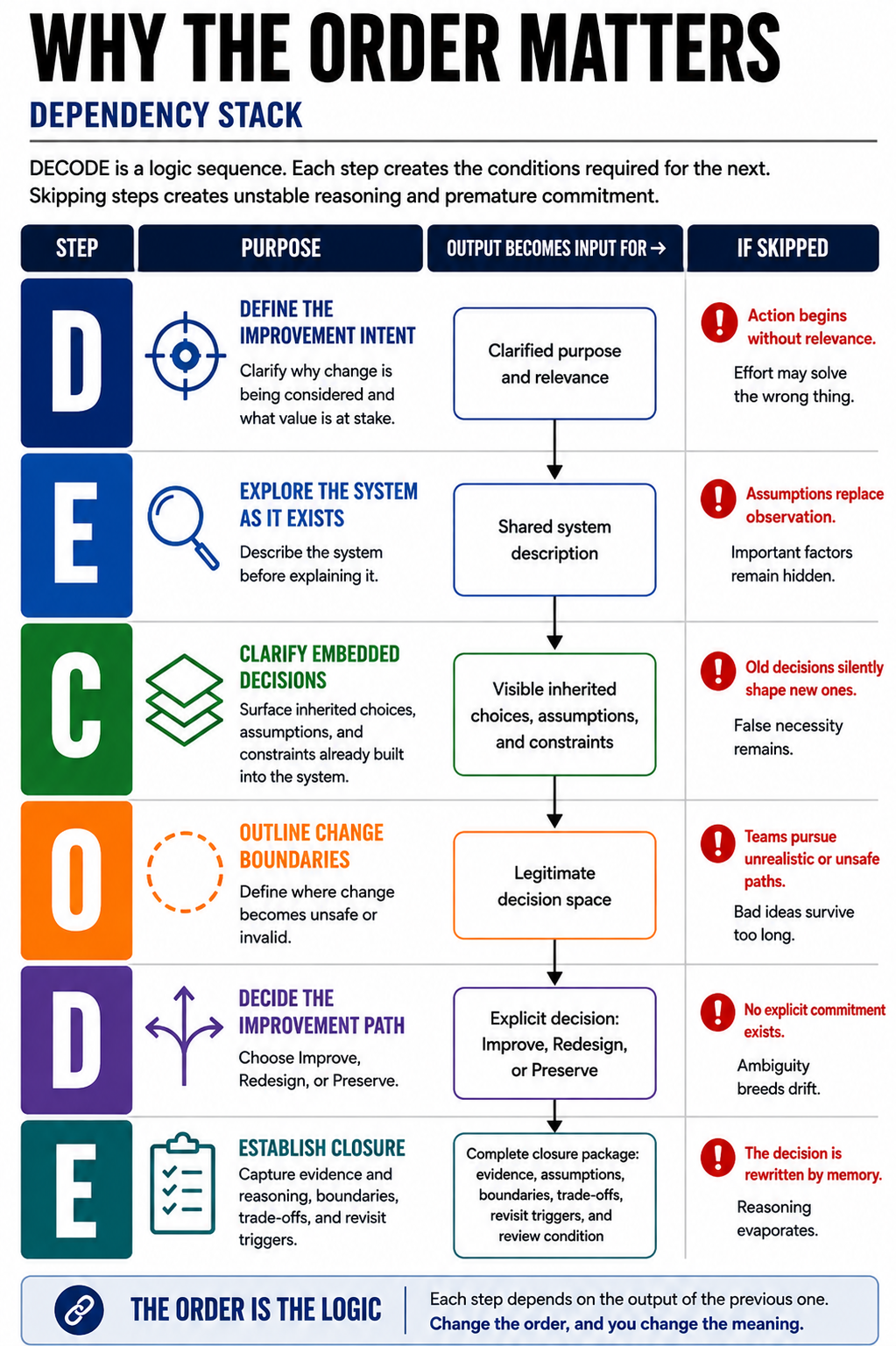
The order of the DECODE steps is not arbitrary. Each step answers a different question, and each question depends on the previous one being resolved. When steps are skipped or reordered, later reasoning is built on unstable ground. Defining intent after proposing solutions distorts purpose. Explaining system behavior before observing it embeds assumptions. Evaluating options before boundaries are understood invites unrealistic commitments. When the order is violated, reasoning becomes circular. Conclusions begin to justify their own premises. The appearance of logic remains, but its foundation is weak. Following the order protects thinking from itself.
Why It Is Not a Cycle#
DECODE is deliberately not a cycle. Many improvement methods are cyclical by design. They assume continuous adjustment and ongoing iteration. DECODE serves a different purpose. Its job is to support a decision at a specific moment in time. Once a decision has been made and closure has been established, DECODE stops. Execution begins afterward. Learning continues, but it no longer belongs to the decision phase. Mixing the two blurs accountability and invites reinterpretation of intent. Revisiting a decision is allowed. Rewriting it continuously is not. When conditions change materially, DECODE can be used again. But each use represents a new decision, not a loop within the same one. This distinction preserves clarity and responsibility. The entire DECODE logic fits on a single page. It is shown here to make one thing clear. Understanding and commitment are deliberately separated. The figure is not a checklist and not a workflow. It is an orientation map. It shows where most organizations commit by accident and where DECODE forces that commitment to be explicit.

Why Separation Protects You#
DECODE relies on separation.
- It separates intent from problems.
- It separates observation from explanation.
- It separates understanding from action.
- It separates decision from execution.
These separations are uncomfortable because they slow the natural rush toward solutions. They also prevent the most common decision failures. When intent is separated from problems, relevance is preserved. When observation is separated from explanation, assumptions are exposed. When understanding is separated from action, learning remains honest. When decision is separated from execution, accountability remains clear.
Without these separations, decisions slide into existence without ever being owned.
The Six Letters as a System#
The six letters of DECODE form a complete logic. Each step produces an output that constrains the next step. Together, they build understanding until commitment can be justified or consciously withheld. The method does not aim to answer every question. It aims to answer the right questions in the right order. This is why DECODE feels strict. And why it works.
The Entire Logic at a Glance#
At its highest level, DECODE enforces a simple rule. No commitment without understanding. No understanding without structure. No structure without discipline.
The next chapters introduce each letter individually. Each chapter focuses on one question that must be resolved before a decision can responsibly move forward. What matters most is not the form of the steps, but the logic they enforce. Once that logic is understood, the method becomes intuitive. Until it is understood, it must be followed deliberately.
Key Takeaway#
DECODE is not a checklist and not a cycle. It is a sequence designed to protect decision quality by enforcing understanding before commitment. The chapters that follow examine each letter in detail, beginning with the first and most commonly misunderstood step. Defining intent. That is where every justified decision begins.