Part II · What DECODE Actually Is (And Isn't)
04What DECODE Is
PART II What DECODE Actually Is (And Isn’t)#
“Let’s start and refine the decision as we go.” This sentence sounds reasonable. It suggests flexibility, learning, and pragmatism. In practice, it often replaces decision discipline with momentum. Action begins before the basis for commitment is clear, and learning is expected to correct the decision after it has already been made. DECODE exists to prevent this pattern. It exists to make commitment justifiable under uncertainty. That is its only job. DECODE is not concerned with speed, consensus, or optimization. It does not attempt to eliminate uncertainty or guarantee correct outcomes. It exists to protect decision quality in situations where uncertainty is unavoidable and the cost of reversal is high. Before explaining how DECODE works, it is necessary to clarify what it is and what it is not. Many decision methods fail not because they are poorly designed, but because they are applied to problems they were never meant to address.
A Discipline for Decision Quality Under Uncertainty#
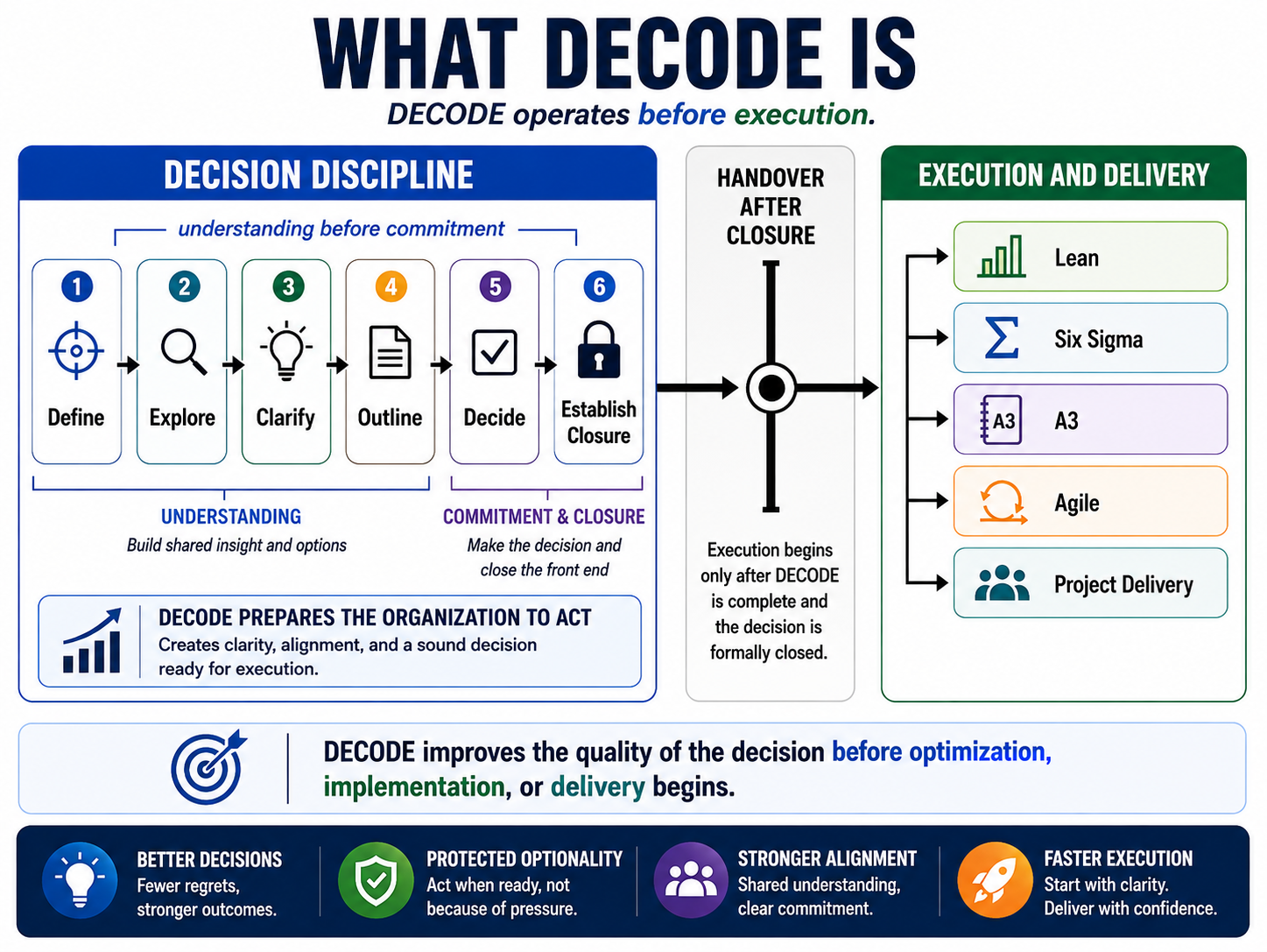
DECODE is a decision discipline. It is used when an organization is unsure whether change is justified, what form that change should take, or how far commitment should extend. These situations are typically marked by incomplete understanding, competing explanations, and pressure to act. In such conditions, the primary risk is not slow execution. It is premature commitment. DECODE structures thinking so that understanding is built deliberately before action is chosen. It separates observation from explanation, explanation from decision, and decision from execution. This separation allows learning to inform commitment rather than serve it after the fact. The method does not remove uncertainty. It makes uncertainty explicit and manageable at the moment when decisions are made.
What DECODE Is Not#
Clarity about what DECODE is requires equal clarity about what it is not.
Not a Solution Method#
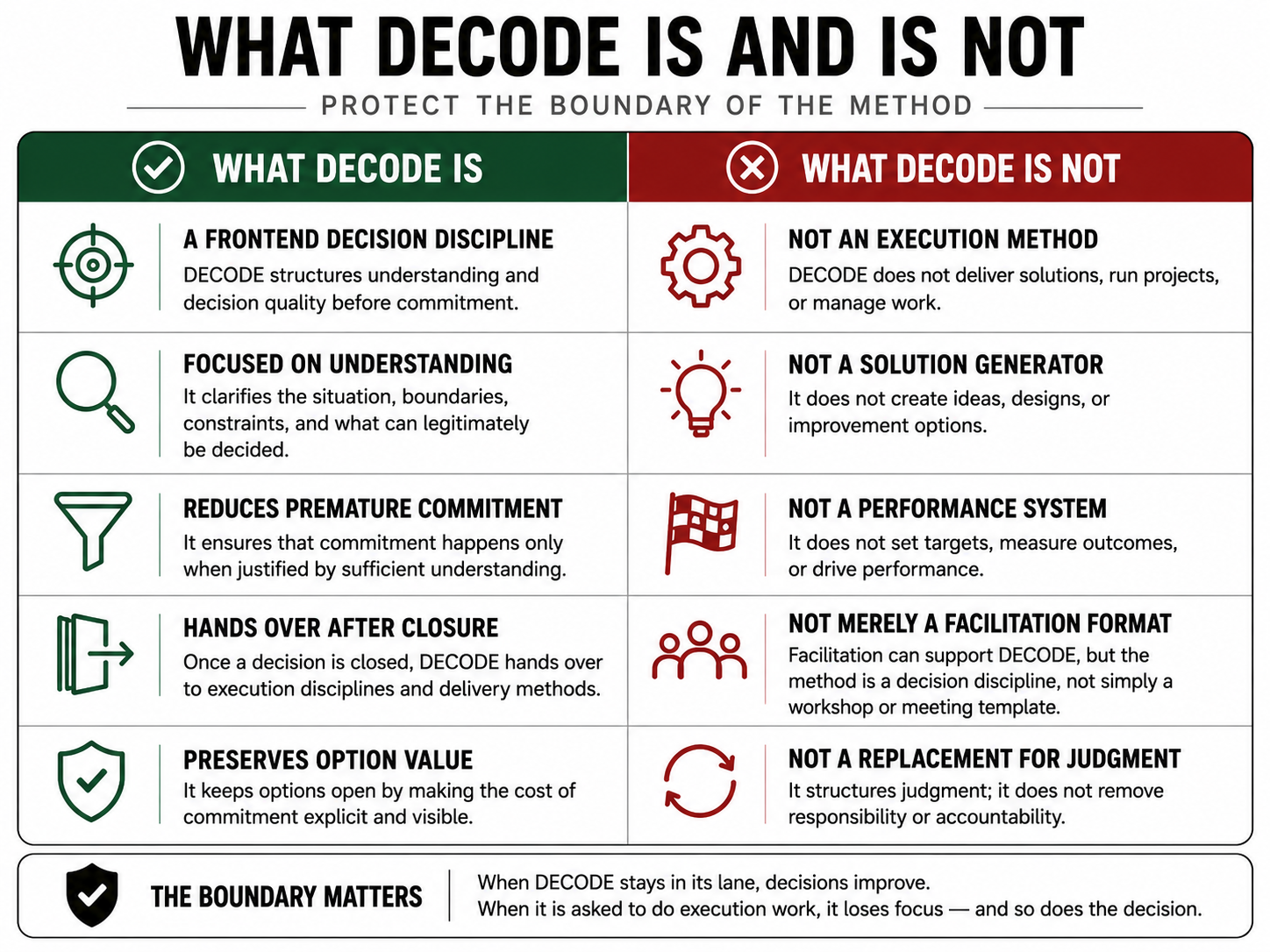
DECODE does not generate solutions. It does not brainstorm options, select technologies, or design processes. It does not tell teams what to build or how to build it. Those activities belong to execution -oriented methods that assume a justified direction already exists. Using DECODE to search for solutions misunderstands its purpose. Its role ends only after a decision has been made and closure has been established. Execution begins afterward, using whatever delivery methods are appropriate.
Not a Project Framework#
DECODE is not a project management tool. It does not define phases, milestones, deliverables, or timelines. It does not replace existing governance or delivery structures. It operates before projects begin, at the point where an organization decides whether a project should exist at all. Once the decision has been made and closure has been established, DECODE steps aside. Continuing to apply it during execution adds friction without benefit.
Not a Compliance Tool#
DECODE is not designed to satisfy audits, checklists, or approval gates. It does not exist to prove that a process was followed. It exists to ensure that reasoning is explicit and defensible. If DECODE is treated as a form to be completed or a box to be checked, its value disappears. The discipline relies on honest engagement, not enforcement.
How DECODE Differs from Familiar Methods#
Misuse of decision disciplines often begins with good intent. Readers recognize familiar patterns and assume equivalence where none exists. DECODE is not DMAIC. DMAIC assumes that a problem has been correctly defined and that improvement is justified. DECODE operates before that assumption is safe. DECODE is not A3 problem-solving. A3 structures problem analysis and solution development. DECODE structures understanding before deciding whether problem-solving should occur at all. DECODE is not stage -gate or portfolio governance. Those mechanisms manage approved work. DECODE exists at the moment when approval itself is still in question. Treating DECODE as any of these tools shifts it downstream, where commitment has often already occurred. When that happens, it loses its ability to protect decision quality.
What DECODE Actually Does#
DECODE performs a single function. It forces clarity on the relationship between understanding and commitment. It requires that intent be stated before problems are framed, that systems be described before explanations are proposed, that boundaries be recognized before options are evaluated, and that decisions be captured before execution begins. By doing so, it prevents organizations from sliding into commitment through momentum, pressure, or optimism. The output of DECODE is not a plan. It is a decision that can be explained, defended, and revisited. The distinction becomes clearer when placed side by side.
What DECODE Is - And What It Is Not#
If DECODE is used as any of the items on the right, it will fail quietly.
Why This Matters#
Organizations are skilled at executing work. They are far less skilled at preserving the reasoning that explains why work was chosen in the first place. Without explicit decision discipline, history is rewritten through outcomes. Assumptions are forgotten. Trade-offs disappear. When conditions change, organizations struggle to explain why a path was chosen or whether it should still be followed. DECODE addresses this gap.
It does not promise better results. It promises better decisions.
Key Takeaway#
DECODE is not a way to act faster. It is a way to decide responsibly. Its only purpose is to make commitment justifiable when understanding is incomplete. The next chapter explains what DECODE is often mistaken for, and why those misunderstandings quietly undermine decision quality.