Part Appendix · Practical Tools
Appendix CThe One-Page DECODE Cheat Sheet
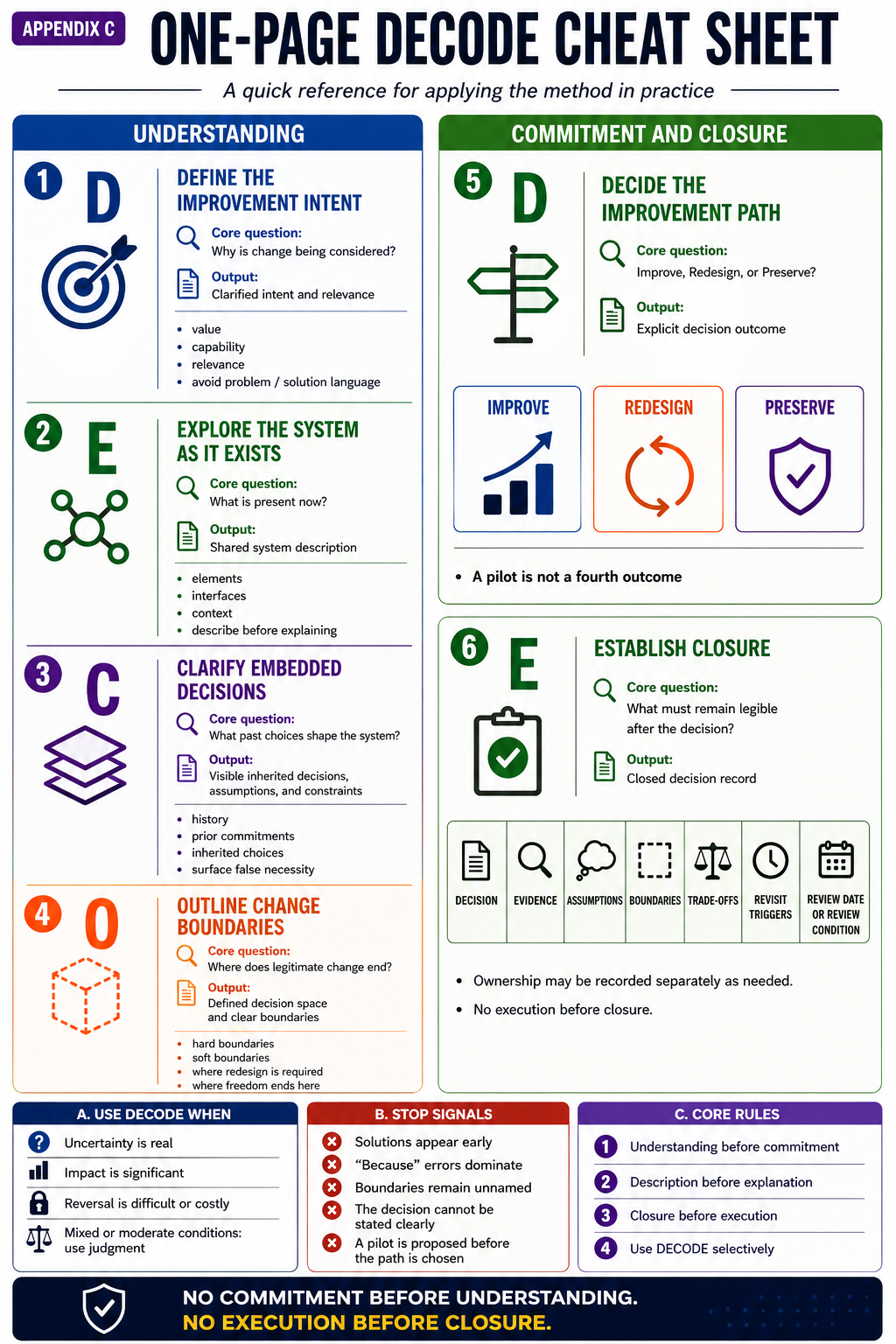
DECODE / Decision Discipline Cheat Sheet#
Purpose#
DECODE is a structured discipline for deciding when commitment is justified under uncertainty. It is not a solution method and not an execution framework. Use DECODE when:
- Uncertainty is real
- The cost of being wrong is high
- Reversal will be difficult Do not use DECODE for low-risk, easily reversible decisions, mandatory decisions with no discretion, routine decisions governed by a proven method, immediate emergency response, or work that simply operates within an already justified structure.
D Define the Improvement Intent#
Why are we even considering change? Clarify the value or capability that matters enough to disturb the current system. Focus on:
- Relevance, not problems
- Value, not metrics
- Direction, not action Do not include:
- Solutions
- Root causes
- Targets or KPIs A good intent creates space for exploration and feels slightly uncomfortable.
E Explore the System as It Exists#
What does the system actually look like right now? Describe before you explain. Capture:
- Elements that make up the system
- Interfaces where elements interact
- Context that shapes behavior Separate:
- Observation from interpretation If you start explaining why something happens, stop and return to description.
C Clarify Embedded Decisions#
Which past decisions are shaping what we see? Make visible:
- Intentional decisions
- Inherited decisions
- True constraints
- Historical accidents Distinguish:
- Constraints from assumptions This step prevents false necessity and restores choice.
O Outline Change Boundaries#
Where does change become unsafe or invalid? Define limits early:
- Physical boundaries
- Regulatory boundaries
- Organizational boundaries Boundaries are not obstacles. They eliminate bad options before commitment occurs. Late boundaries create fragile decisions.
D Decide the Improvement Path#
Given what we now understand, what do we commit to? Only three valid outcomes exist:
- Improve within existing boundaries
- Redesign beyond existing boundaries
- Preserve and do not change These are decision paths, not detailed solutions. They define the level and boundary of commitment. Detailed solution design occurs after closure. A decision is a commitment, not a plan. If the decision cannot be stated clearly in two sentences, it is not ready.
E Establish Closure#
How do we protect this decision from being rewritten later? Capture:
- Decision statement
- Supporting evidence and reasoning
- Key assumptions
- Boundaries and scope
- Accepted trade-offs
- Revisit triggers
- Review date or review condition Closure preserves reasoning, not outcomes. Closed decisions become organizational assets.
Core Rules to Remember#
Understanding must come before commitment. Description must come before explanation. Boundaries must come before options. Decisions must be explicit and closed. DECODE stops only after a decision has been made and closure has been established. Execution begins afterward. When this logic becomes habitual and formal DECODE is used selectively, decision quality has matured.