Part Appendix · Practical Tools
Appendix DFacilitating a DECODE Conversation
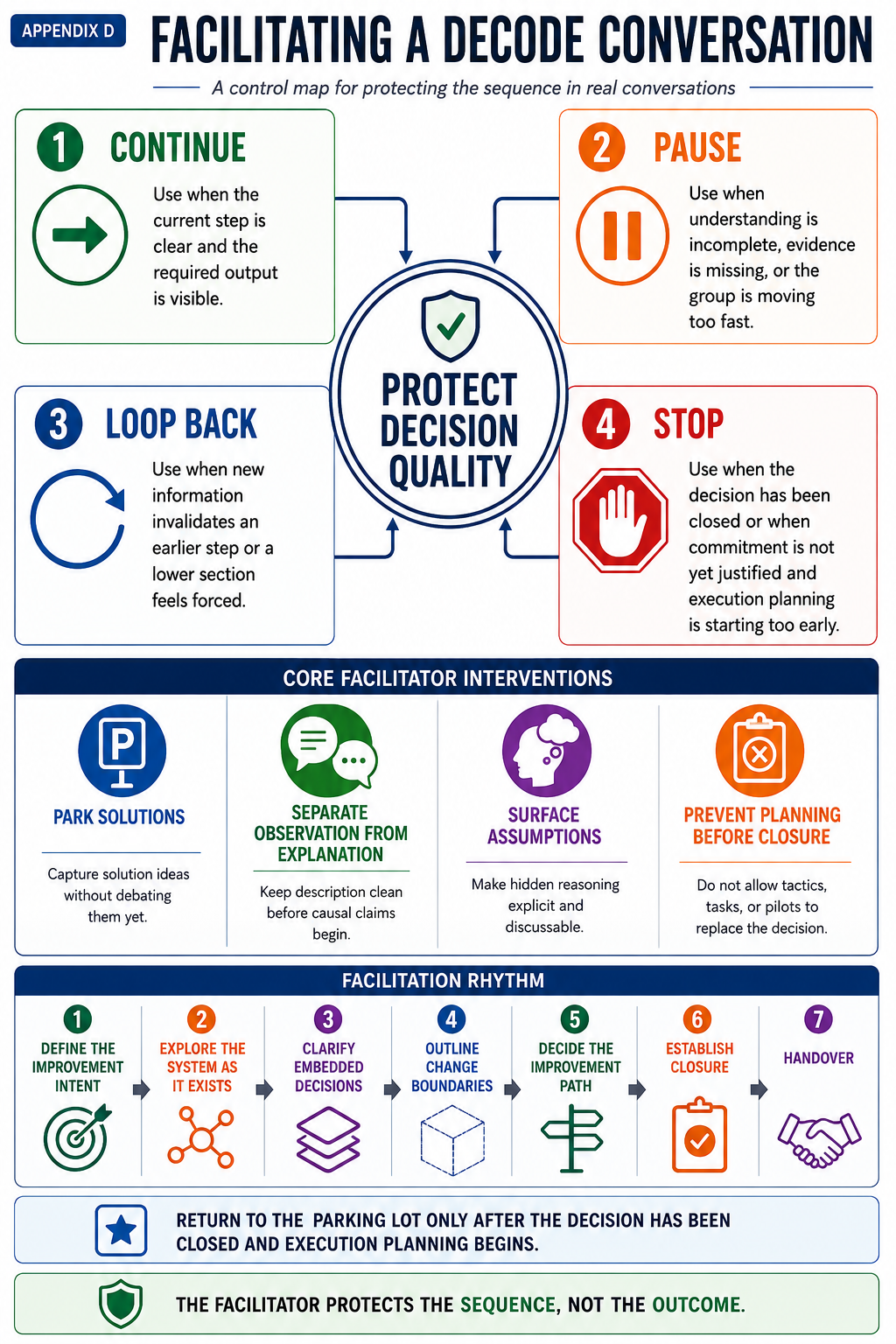
DECODE / Meeting Facilitation Guide#
What This Meeting Is#
This meeting exists to decide whether commitment is justified. It is neither a problem-solving session nor an execution review. Your role as facilitator is to:
- Protect the sequence
- Slow the conversation where it rushes
- Stop commitment from forming accidentally If people feel slightly uncomfortable, the meeting is working.
Ground Rules to Set at the Start#
- We will not discuss solutions until allowed
- Disagreement is expected and useful
- Pausing is allowed
- Pausing without a decision is a valid meeting result when understanding is insufficient State clearly when the meeting will stop and what decision is expected, if any.
D Define the Improvement Intent#
Facilitator question: Why are we even considering change? What you are listening for:
- Value or capability language
- Relevance, not complaints What you must stop:
- Problem statements
- Solutions
- Metrics and targets If intent sounds energizing or obvious, it is probably too close to a solution. Do not proceed until intent is clear enough to support further exploration.
E Explore the System as It Exists#
Facilitator question: What does the system look like right now? What you are listening for:
- Description of elements
- Interfaces and handovers
- Context and conditions What you must stop:
- Explanations
- Root causes
- The word because If explanations appear, redirect to observation. Disagreement here is a signal of incomplete shared understanding. Do not resolve it yet.
C Clarify Embedded Decisions#
Facilitator question: Which past decisions shaped what we see? What you are listening for:
- Intentional versus inherited choices
- Constraints versus habits
- Workarounds and legacy decisions What you must stop:
- Treating history as inevitability
- Defending the current state This step often feels political. Slow down rather than push through.
O Outline Change Boundaries#
Facilitator question: Where does change become unsafe or invalid? What you are listening for:
- Physical limits
- Regulatory limits
- Organizational limits What you must stop:
- Treating assumptions as boundaries
- Ignoring uncomfortable limits If boundaries eliminate favored options, that is success. Late boundaries create fragile decisions.
D Decide the Improvement Path#
Facilitator question: Given what we understand, what do we commit to? Only three acceptable answers:
- Improve
- Redesign
- Preserve What you must stop:
- Hybrid outcomes
- Pilots without commitment
- Deferred decisions disguised as action Ask for the decision to be stated in two sentences. If that is not possible, loop back or pause.
E Establish Closure#
Facilitator question: How do we prevent this decision from being rewritten later? Capture explicitly:
- What was decided
- The evidence and reasoning supporting the decision
- Key assumptions
- Boundaries and scope
- Trade-offs accepted
- Conditions that trigger revisit
- Review date or review condition Do not allow execution planning to replace closure. Closure ends the meeting.
When to Pause#
Pause the meeting if:
- Understanding is clearly incomplete
- New information is required
- Discussion turns defensive or circular Pausing is cheaper than committing prematurely.
When to Loop Back#
Loop back if:
- Intent is revealed to be misframed
- Boundaries invalidate earlier reasoning
- Embedded decisions change the context Looping back is refinement, not failure.
When to Stop#
Stop immediately when:
- A decision is made and closed Continuing after closure causes drift and reinterpretation.
Final Reminder for the Facilitator#
Your job is not to create speed. Your job is to protect decision quality. If people leave frustrated but clear, the meeting succeeded. If people leave energized but vague, it failed.
DECODE / Facilitator One-Slide Card#
Purpose of this meeting Decide whether commitment is justified under uncertainty. This is not a problem-solving or execution meeting.
Ground Rules#
- No solutions until allowed
- Disagreement is useful
- Pausing is allowed
- Pausing without a decision is a valid meeting result when understanding is insufficient
D Define the Improvement Intent#
Ask: Why are we even considering change? Stop: Problems, solutions, metrics Check: Does this describe value, not action?
E Explore the System as It Exists#
Ask: What does the system look like right now? Allow: Description only Stop: Explanations and the word “because”
C Clarify Embedded Decisions#
Ask: Which past decisions shaped this? Surface: Inherited choices, habits, workarounds Watch: Defending history as inevitable
O Outline Change Boundaries#
Ask: Where does change become unsafe or invalid? Name: Physical, regulatory, organizational limits Accept: That boundaries may eliminate favored ideas
D Decide the Improvement Path#
Ask: What do we commit to? Only options: Improve, Redesign, Preserve Rule: If it can’t be said in two sentences, stop
E Establish Closure#
Capture: Decision, evidence and reasoning, assumptions, boundaries and scope, trade-offs, revisit triggers, review date or condition End: No planning before closure
Facilitator Authority#
Pause if understanding is incomplete Loop back if framing collapses Stop when the decision is closed
Reminder#
Protect decision quality, not momentum. Clear and uncomfortable beats fast and vague.
DECODE / Executive Decision Discipline#
Purpose of this discussion Decide whether commitment is justified. This is not an execution update or solution review.
Rules of Engagement#
- We decide before we act
- We surface disagreement early
- We may pause or choose not to act
- Closure ends the discussion
D Define the Intent#
Question: Why is change worth considering now? Listen for: Value and relevance Stop: Problems, solutions, targets
E Explore the System#
Question: What does the system look like today? Require: Description, not explanation Stop: Causes, opinions, “because”
C Clarify Embedded Decisions#
Question: Which past choices are shaping this? Surface: Legacy constraints and assumptions Watch: “This is just how it is”
O Outline Boundaries#
Question: Where does change become unsafe or invalid? Name: Physical, regulatory, organizational limits Accept: Good ideas being eliminated
D Decide the Path#
Question: What do we commit to? Only outcomes: Improve, Redesign, Preserve Rule: Two sentences or we are not ready
E Establish Closure#
Record: Decision, evidence and reasoning, assumptions, boundaries and scope, trade-offs, revisit triggers, review date or condition End: No planning before closure
Chair Authority#
Pause if understanding is weak Redirect if discussion collapses into solutions End the meeting once the decision is explicit and closure has been established
Final Reminder#
Speed feels decisive. Clarity is decisive.