Part I · The Real Problem
01The Hidden Cost of Deciding Too Early
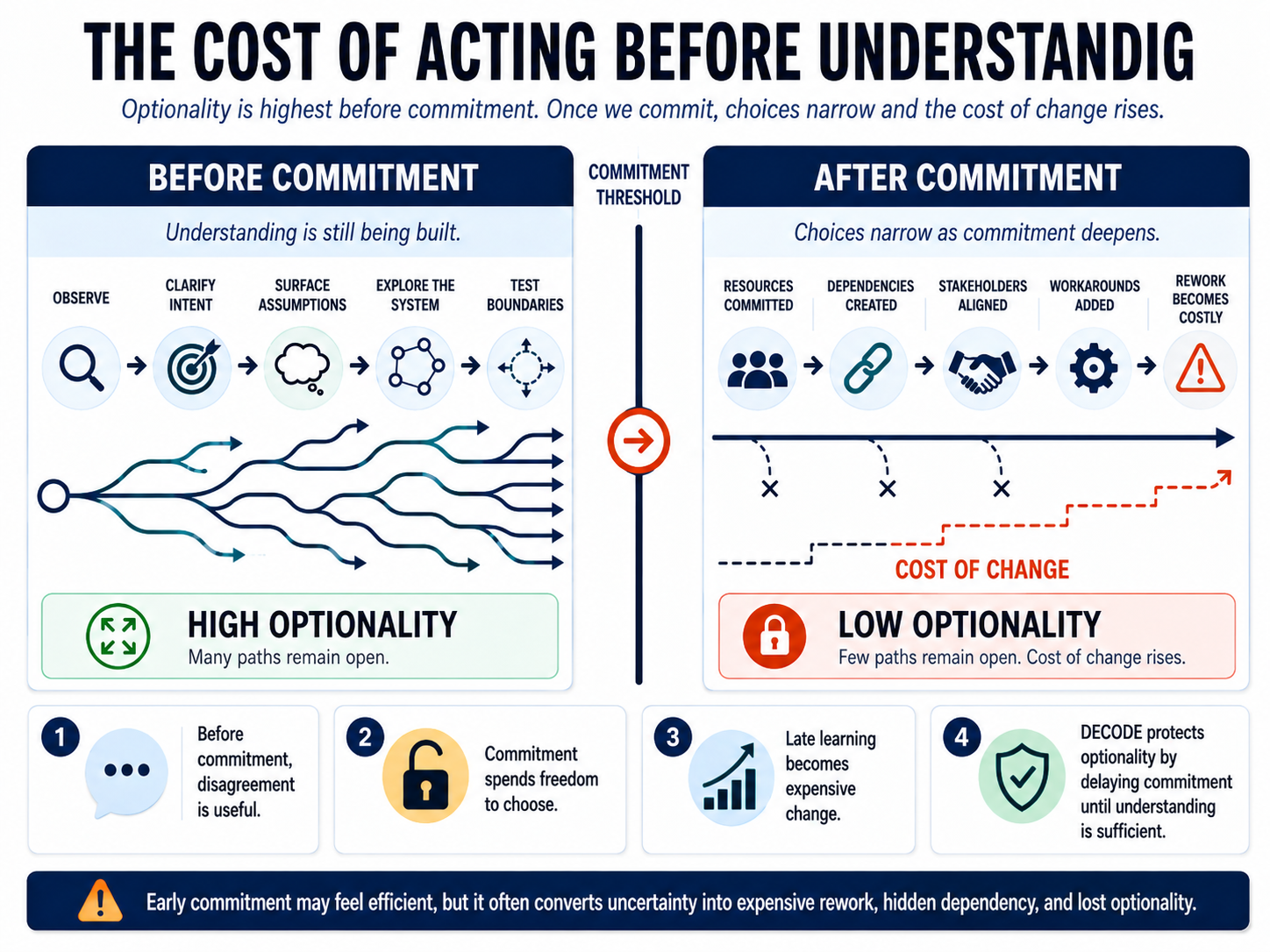
“If we act fast, we’ll figure it out later.” This sentence rarely appears in formal documentation. It is spoken informally, often with confidence and good intent. It signals urgency, momentum, and competence. It reassures teams that uncertainty will resolve itself through progress. In many organizations, it is treated as a virtue. It is also one of the most expensive assumptions in modern technical and managerial work. The danger of this sentence is not recklessness. It is plausibility. It sounds experienced, pragmatic, and grounded in action. In simple or reversible situations, it often works. But when systems are complex, coupled, or costly to change, this logic quietly converts uncertainty into commitment.
By the time understanding improves, freedom to choose has already been spent.
It usually starts small. A product tweak. A process adjustment. A “minor” improvement suggested by someone experienced and well-intentioned. The change makes sense. It addresses a visible issue. It feels responsible. The team moves quickly. The change is implemented. Early results look fine. Months later, failures appear in places no one expected. Variability increases. Costs creep up. Exceptions multiply. Workarounds become normal. When the issue is finally escalated, no one can clearly explain why the change was made in the first place. By then, reversing it would require admitting that the original decision itself, not the execution, was flawed. So the organization keeps optimizing around it. This is not an execution failure. It is what a decision failure looks like when it takes time to surface.
Why Most Failures Start Before Execution#
When initiatives fail, explanations usually point downstream. Execution was weak. Discipline was lacking. Resistance was underestimated. Communication broke down. These explanations are comforting. They imply that the decision itself was sound and that success would have followed with better follow-through. In reality, many failures originate earlier. They begin at the moment a decision is made before the system is sufficiently understood. Problems are framed too narrowly. Constraints are assumed rather than explored. Boundaries that should have guided thinking are discovered only after resources, credibility, and options have already been committed. These are not execution failures. They are decision failures. Execution excellence cannot compensate for premature commitment. In fact, it often amplifies the damage by efficiently driving the organization in the wrong direction. The distinction can be summarized simply. The two failure modes look similar on the surface, but they require fundamentally different responses.

Decision Failure Versus Execution Failure#
An execution failure occurs when the direction is clear but delivery is poor. The goal is understood. The system boundaries are known. Action is unavoidable. What is required is rigor, discipline, and consistency. A decision failure looks different. It arises when the direction itself is unstable. When there is pressure to act without shared understanding. When multiple explanations remain plausible. When system boundaries are unclear. When solutions appear before the situation has been framed. In these situations, acting feels easy while understanding feels slow and uncomfortable. Organizations frequently misclassify decision failures as execution problems. They respond by accelerating action, tightening controls, and reinforcing delivery mechanisms. This response feels productive. It is often counterproductive.

When the decision itself is weak, better execution only locks it in faster.
Why Outcomes Lie#
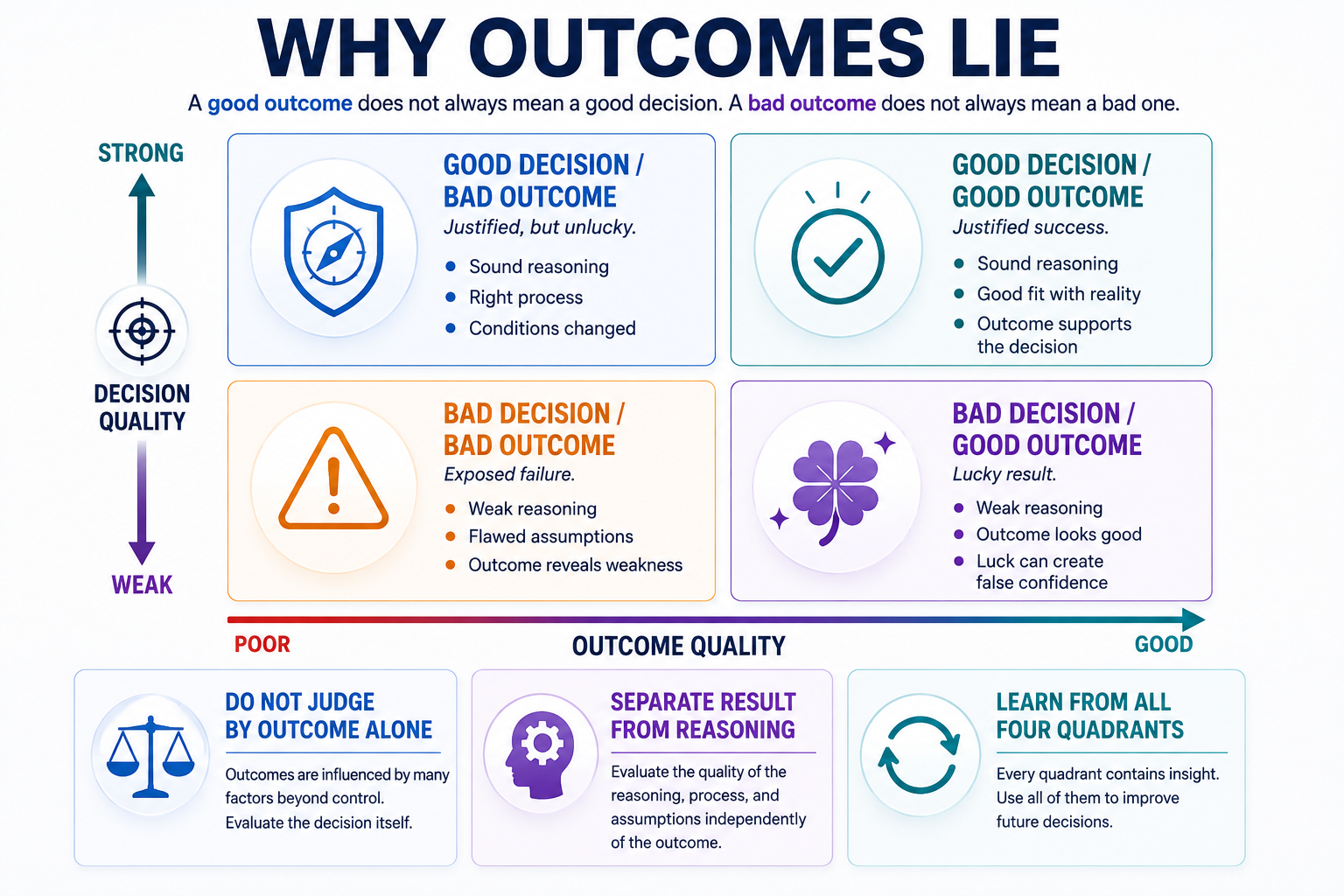
Outcomes are unreliable judges of decision quality. A well-structured decision can lead to poor outcomes if conditions change. A poorly structured decision can appear successful if circumstances are favorable. When organizations judge decisions only by results, they confuse luck with quality and hindsight with learning. This confusion is reinforced over time. As memory fades, intent is rewritten to match outcomes. Assumptions are forgotten. Boundaries that were never named appear inevitable in retrospect. When outcomes disappoint, explanations are reconstructed around execution. When outcomes succeed, the decision is assumed to have been obvious all along. In both cases, the original reasoning is lost. Without explicit preservation of intent and assumptions, organizations cannot distinguish between a bad decision and a good decision undermined by change. Learning becomes storytelling rather than analysis.
The Illusion of Progress#
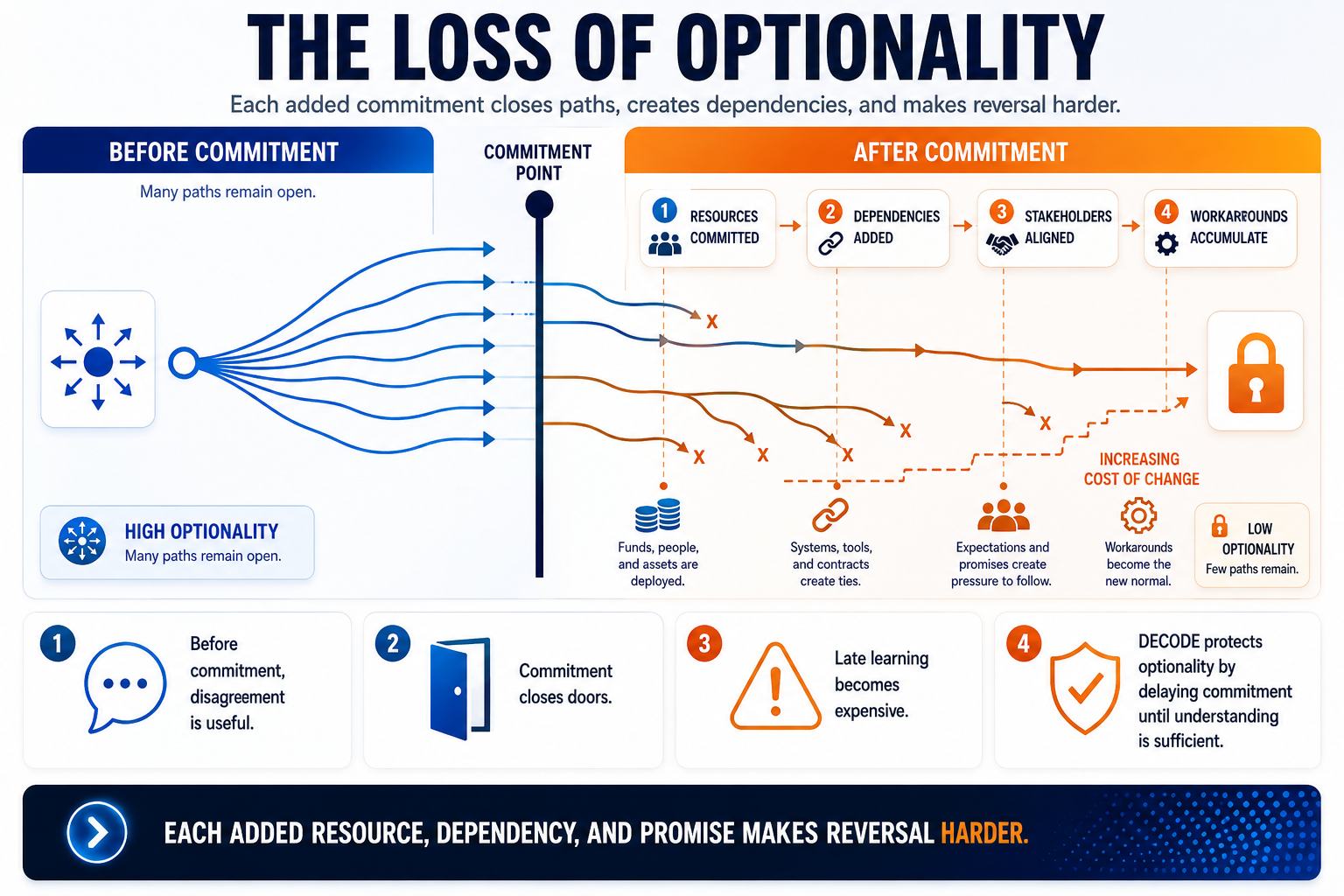
One of the most deceptive aspects of deciding too early is that it often looks like progress. Teams become busy. Artifacts are created. Milestones are reached. Reviews are held. Alignment appears to increase. These signals create confidence that the decision was correct. But activity is not understanding. In many cases, early action serves primarily to justify itself. Evidence is filtered through the chosen direction. Constraints discovered late are treated as obstacles rather than signals. Alternatives fade, not because they were examined and rejected, but because returning to them would be costly. Progress continues, but freedom shrinks. The organization becomes committed not because the decision was justified, but because reversing it now feels more expensive than continuing.
The Cost of Wrong Commitment#
The true cost of acting before understanding is not wasted effort. It is the loss of optionality. Once commitment occurs, decisions become harder to revisit. Political, emotional, and financial investments accumulate. Changing direction requires justification, explanation, and sometimes apology. As a result, organizations tolerate increasing complexity, rework, and fragility to avoid reopening the decision itself. This cost appears late, when change is hardest and learning is most painful.
Key Takeaway#
Fast action feels good. Wrong commitment is expensive. The most important question is not how fast an organization can move, but when movement should become commitment. This book exists to address that moment. Before introducing the DECODE method itself, one distinction must be made clear. Not every situation requires this level of discipline. Some problems are execution problems. Others are decision problems. Knowing the difference is where we turn next.