Part I · The Real Problem
02Two Types of Problems Most Teams Confuse
We are optimizing before we know what problem we’re solving. Most organizations apply execution discipline to situations that require decision discipline. This mistake is rarely visible in hindsight, because action creates movement, artifacts, and the appearance of progress. Yet it is one of the most reliable ways organizations lock themselves into fragile commitments. The root of the problem is not a lack of tools. It is the misclassification of the situation itself. Organizations frequently confuse execution problems with decision problems. Both involve uncertainty. Both create pressure. Both demand action. But they require fundamentally different responses. Treating one as the other quietly increases risk while giving the impression of control. Before introducing any discipline for decision quality, this distinction must be made explicit.
Execution Problems#
Clear Goal, Unclear Path#
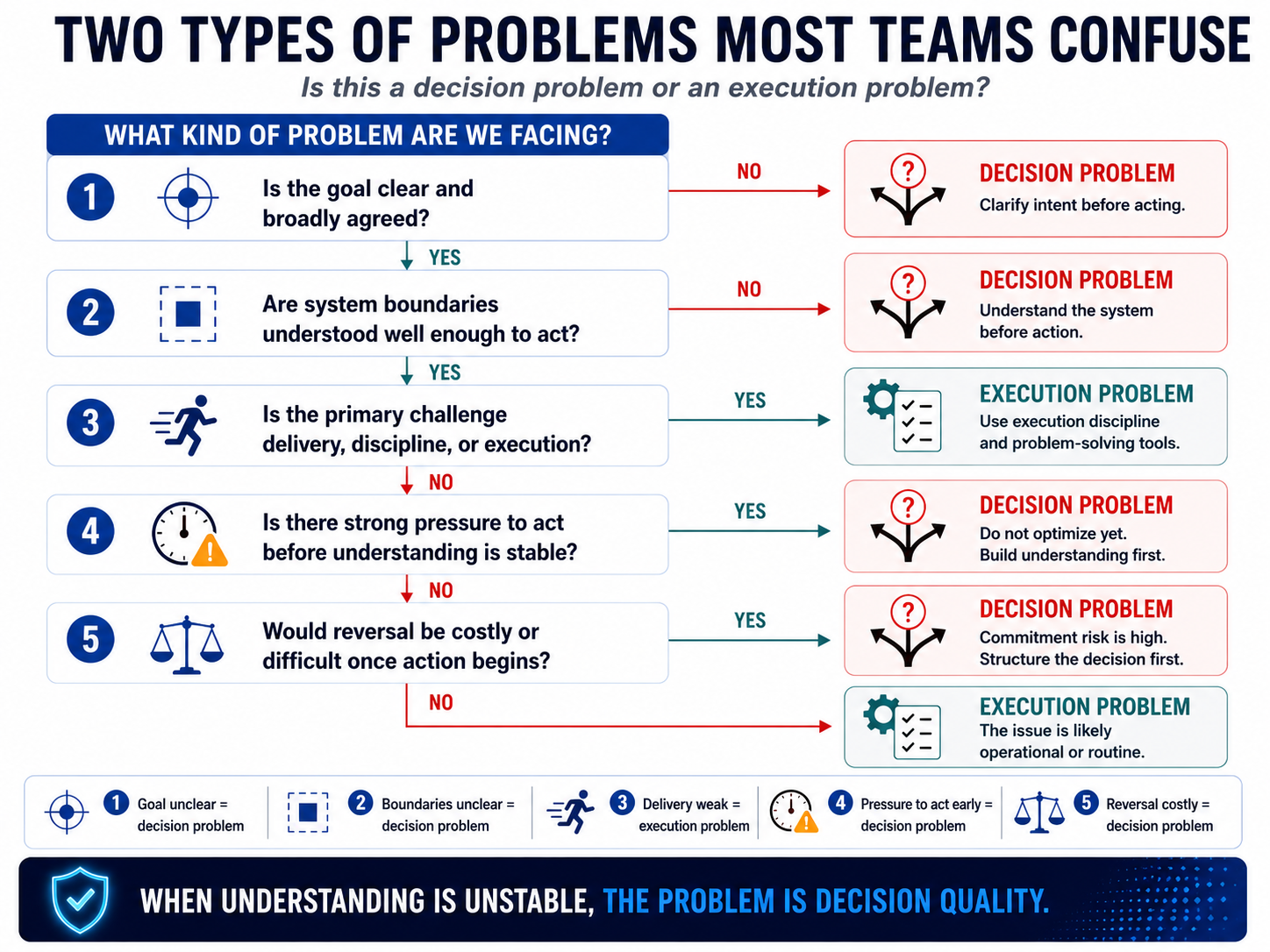
An execution problem exists when the direction of action is already known. The organization understands what needs to change. The goal is clear and broadly agreed. The system boundaries are sufficiently understood to act. The challenge lies not in deciding whether to act, but in executing effectively. Typical examples include excessive scrap, unstable process capability, recurring defects, missed delivery targets, or equipment that no longer meets requirements. In these situations, doing nothing is not a realistic option. The system must be corrected or stabilized. Execution problems share several characteristics:
- The goal is clear
- The situation is understood well enough to act
- Action is unavoidable
- The primary risk lies in poor delivery In these cases, established problem-solving and execution-focused methods are appropriate. Structured problem-solving, corrective action systems, continuous improvement, and delivery discipline add value. Success depends on rigor, consistency, and follow-through. Here, optimization creates value.
Using a decision-structuring method in these situations adds friction without benefit. It delays necessary action and can create frustration. Choosing not to use DECODE when execution is the real issue is a sign of good judgment, not a limitation.
Decision Problems#
Unclear Situation, Pressure to Act#
A decision problem looks different. It does not arise from a clear deviation or failure. It arises from uncertainty about what kind of situation the organization is facing and what form of action, if any, is justified. Decision problems are often triggered by signals rather than facts. Competitive pressure. Emerging trends. Isolated data points. Strong opinions. A sense that something should be done, even if no one agrees on what that something is. Common signals include:
- Pressure to act without shared understanding
- Multiple plausible explanations supported by partial or conflicting evidence
- Disagreement about system boundaries
- Solutions proposed before understanding stabilizes
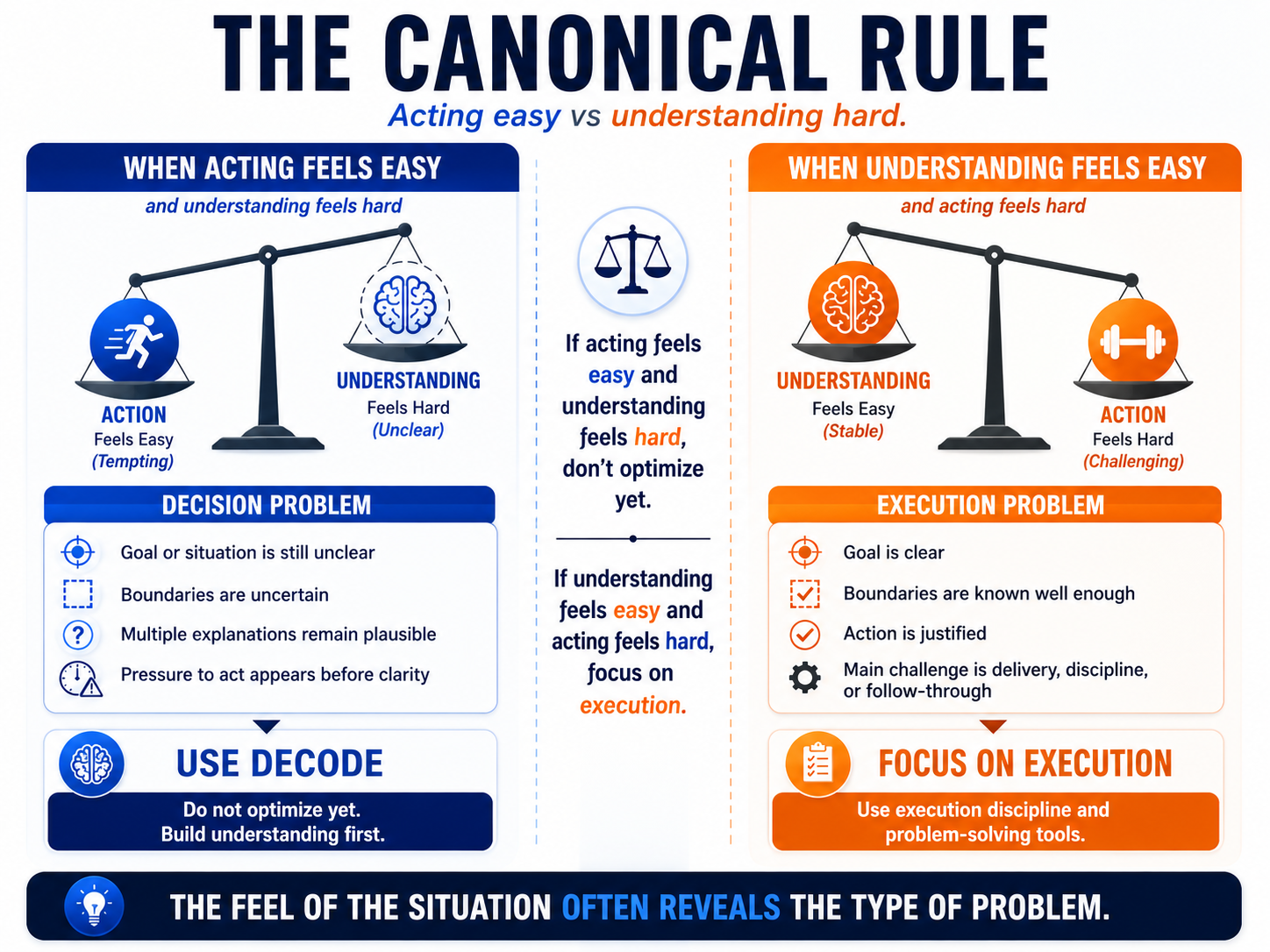
- Discomfort with the option of not acting In these situations, acting feels easier than understanding. Action provides relief from ambiguity. It creates momentum and visible progress. Understanding, by contrast, feels slow, incomplete, and uncomfortable. This is precisely where decision quality is most at risk.
Fast Diagnostic#
In practice, teams rarely pause to ask whether they are facing an execution problem or a decision problem. They act as if the answer is obvious. The following signals are often more reliable than formal definitions. If the team cannot agree on what success would look like, it is a decision problem. If system boundaries cannot be named without disagreement, it is a decision problem. If the first proposed response is already a solution, it is a decision problem. If acting feels easier than understanding, it is a decision problem. Execution problems feel different. The frustration comes from difficulty in delivery, not from uncertainty about direction. Misclassifying the situation is itself a decision. Its consequences usually appear much later.
When Problem-Solving Tools Help#
Problem-solving and execution tools are powerful when applied to the right kind of problem. When the goal is clear and the system is understood well enough to act, these tools reduce variation, restore stability, and improve performance. They assume that the direction of improvement is valid and that the primary challenge lies in delivery. In execution problems, this assumption holds. Applying problem -solving methods in these situations accelerates learning and creates value. Optimization is appropriate because the boundaries are known and the cost of acting incorrectly is limited or unavoidable.
When They Quietly Hurt You#
The same tools can quietly increase risk when applied to decision problems. When understanding is incomplete, starting optimization too early collapses thinking. Solutions appear before the situation is framed. Evidence is filtered through preferred actions. Boundaries are discovered late and treated as obstacles rather than signals. This behavior feels productive. Teams are busy. Artifacts are created. Progress appears visible. But the organization is no longer learning in order to decide. It is learning in order to justify. Strong execution under these conditions does not correct a weak decision. It accelerates commitment to it. Resources are deployed efficiently. Dependencies are created quickly. Reversal becomes harder sooner. What began as a decision problem turns into a sunk-cost trap.
The Canonical Rule#
The distinction between execution problems and decision problems can be summarized in a simple experiential rule:
- If acting feels easy and understanding feels hard, don’t optimize yet.
- If understanding feels easy and acting feels hard, focus on execution. This rule is intentionally subjective. It reflects how risk is experienced in practice rather than how it is documented in procedures. When teams disagree about which type of problem they are facing, this rule should be discussed explicitly. Misclassifying the situation is itself a decision with consequences.
Key Takeaway#
Execution problems require action. Decision problems require understanding. Problem-solving tools are powerful when the goal is clear. When the situation is unclear, they can quietly lock organizations into fragile commitments. Knowing which type of problem you are facing determines whether optimization creates value or destroys it. The next chapter addresses one of the strongest forces pushing organizations toward premature action. Before understanding can be protected, the pressure to act must be examined directly.