DECODE digital edition
IntroductionThe Cost of Acting Before Understanding
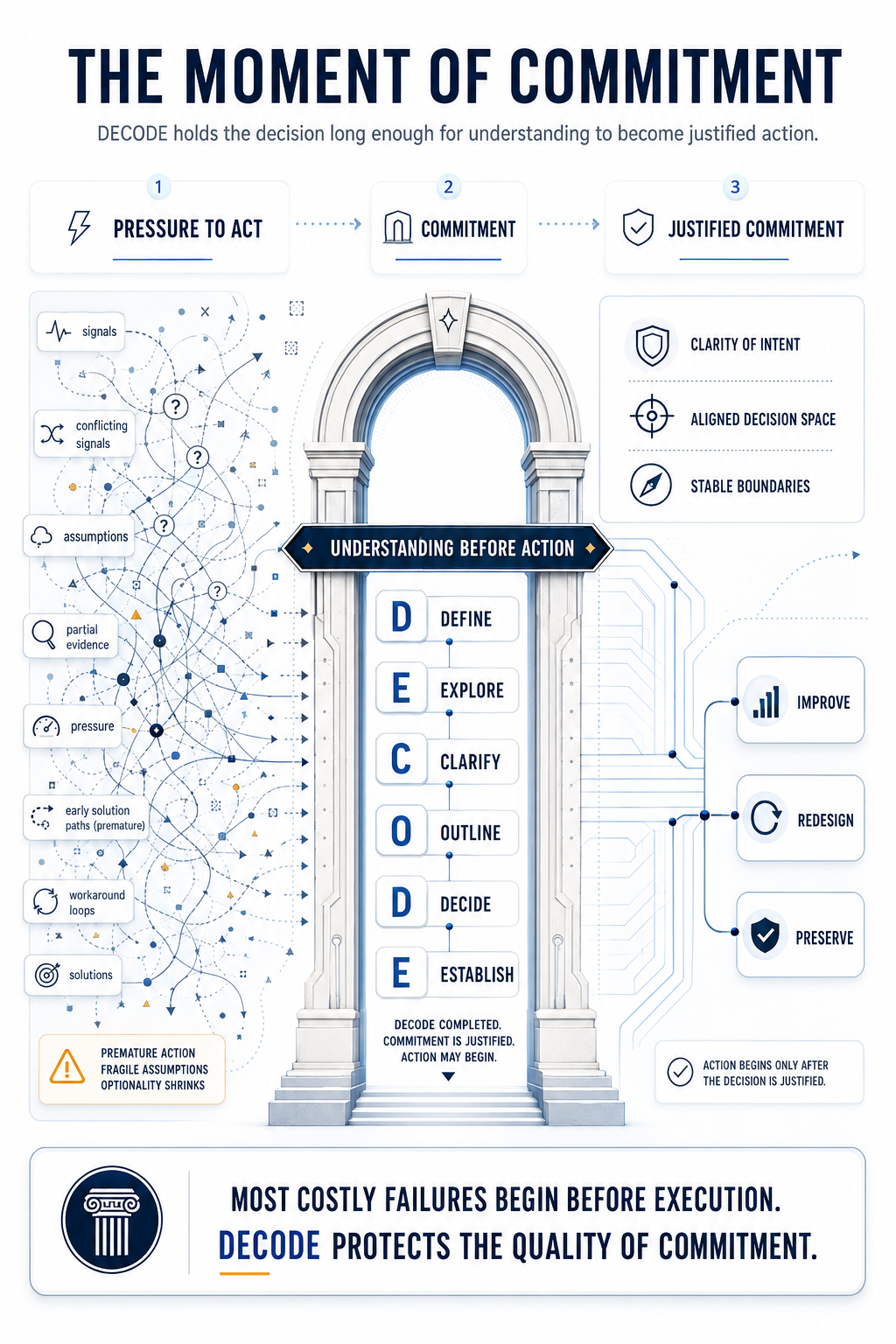
“If we act fast, we’ll figure it out later.” This sentence appears in meetings, design reviews, and strategy discussions across industries. It is rarely written down, but it is often implied. It signals urgency, confidence, and momentum. It reassures teams that uncertainty will resolve itself through action. In many organizations, it is treated as a sign of competence. And yet, this sentence is responsible for more fragile decisions than almost any other idea in modern technical and managerial work. Most costly failures do not begin with poor execution. They begin earlier, at the moment of commitment. A decision is made before the system is sufficiently understood. Problems are framed too narrowly. Constraints are discovered too late. Boundaries that should have guided thinking are encountered only after resources, credibility, and options have already been spent. When outcomes disappoint, explanations are usually sought downstream. Execution was weak. Resistance was underestimated. Discipline was lacking. Rarely is the decision itself examined with the same rigor as the work that followed it. This book is about that earlier moment. It is about decisions made under uncertainty, where the pressure to act is high and the cost of reversal is real. It is about situations where doing something feels responsible, but understanding feels incomplete. And it is about why organizations repeatedly commit to paths that later become difficult to explain, defend, or undo. DECODE is a discipline for decision quality. It does not optimize execution. It does not generate solutions. It does not guarantee success. Its purpose is simpler and more demanding: to ensure that commitment is justified before action begins. The method separates understanding from action. It forces clarity on why change is being considered, what system is actually involved, which past decisions are already embedded, where change is constrained, and what can legitimately be decided given current knowledge. Only after these questions are addressed does it allow commitment to occur. Sometimes that commitment leads to improvement. Sometimes it leads to redesign. Sometimes it leads to the disciplined decision not to change.
All three outcomes are valid when they are supported by understanding. This book is written for engineers, managers, and leaders who are accountable not only for delivering results, but for deciding when action is justified. It assumes competence. It assumes good intent. And it assumes that uncertainty is an unavoidable part of real work, not a failure to be corrected by confidence. If acting fast has ever felt easier than understanding properly, this book is for you. This book is not about learning a new framework. It is about changing what happens before frameworks are applied. By the end of this book, you will be able to recognize decision problems early, before they are mistaken for execution failures. You will be able to hold a room in uncertainty without collapsing into premature action. And you will be able to close decisions deliberately, so they do not get quietly rewritten later through momentum, pressure, or hindsight.
The goal is not to slow work down. The goal is to ensure that when commitment occurs, it is justified.
How to Use This Book#
This book does not need to be read linearly. If you want to understand why organizations commit too early, start with Part I. If you want to understand what DECODE is and is not, go to Part II. If you want the logic of the method itself, read Part III. If you are trying to apply DECODE in real situations, use Part IV and the appendices. If you want to understand what changes when decision discipline matures, read Part V.
The cheat sheet and facilitation scripts are designed to be used before meetings, not after decisions have already formed. You do not need to formally apply DECODE to benefit from this book. The deeper aim is to change how you recognize decisions before they become commitments. You may begin to notice premature solutions, inherited assumptions, hidden boundaries, shrinking optionality, and decisions that were never properly closed. In many situations, that awareness alone is enough to improve judgment. Formal DECODE is reserved for decisions whose uncertainty, consequence, or difficulty of reversal justifies greater discipline.